Geely Fuel vs EV Fenders: Steel, Aluminum, and What Body Shops Need to Know
author: 01
2026-08-21
Geely Fuel vs EV Fenders: Steel, Aluminum, and What Body Shops Need to Know
The automotive aftermarket is witnessing a fundamental shift. As Geely expands its electric vehicle lineup alongside its traditional fuel-powered models, body shops and parts suppliers face a new reality: not all fenders are created equal.
For repair professionals working on Geely Emgrand (fuel) and Geely Geometry C (EV) models, understanding the material differences between steel and aluminum fenders isn't just technical knowledge—it's essential for accurate estimating, proper repair procedures, and customer satisfaction.
Steel Fenders: The Geely Emgrand Standard
The Geely Emgrand, one of Geely's best-selling fuel sedans, primarily employs cold-rolled steel for its body panels, including fenders. The Emgrand body structure uses high-strength steel accounting for more than 59% of its composition, with yield strength and tensile strength engineered to enhance safety performance and body rigidity.
Specifically, Geely sources cold-rolled automotive steel grades including DC01, DC03, and BLD series for body panel applications. These cold-rolled steel grades—part of the DC (European standard) and BLD (Baosteel standard) families—offer excellent formability for stamping complex fender shapes while maintaining structural integrity.
Key characteristics of Geely Emgrand steel fenders:
-
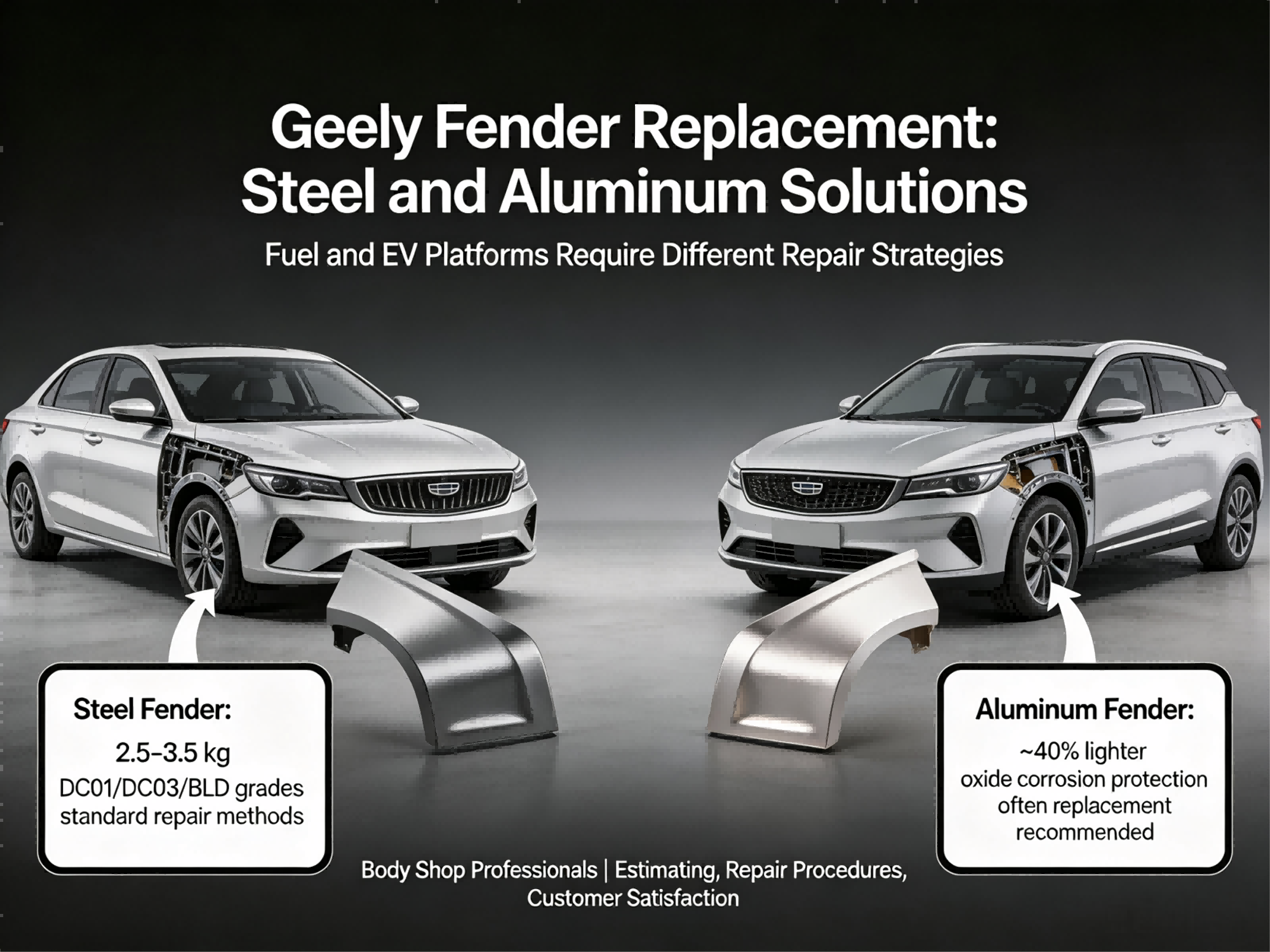
Weight: Steel fenders are heavier, typically weighing 2.5–3.5 kg per panel
-
Strength: High yield strength (130–210 MPa) with tensile strength reaching 270–410 MPa
-
Formability: Excellent for cold stamping processes
-
Corrosion resistance: Cold-rolled steel has limited inherent rust protection; surface damage requires prompt paint repair
Aluminum Fenders: The EV Lightweighting Choice
Electric vehicles demand weight reduction to maximize range. While the Geometry C has seen material changes over its production lifecycle—with some variants switching from aluminum to steel for certain panels—aluminum remains a key lightweighting material in Geely's EV strategy.
Aluminum fenders offer approximately 40% weight savings compared to steel counterparts. With aluminum density at roughly 2.68 g/cm³ versus steel's 7.85 g/cm³, this weight reduction directly translates to improved EV range and handling.
Key characteristics of aluminum fenders:
-
Weight: Approximately 40% lighter than steel
-
Strength-to-weight ratio: Excellent, though aluminum has lower Young's modulus than steel
-
Corrosion resistance: Naturally forms protective oxide layer
-
Repair complexity: Significantly more challenging than steel
The Repair Reality: Why Aluminum Changes Everything
Here's what every body shop needs to understand: aluminum fenders behave fundamentally differently from steel during collision repair.
Steel has "memory"—it can be heated, reshaped, and returned to form. Aluminum, conversely, work-hardens when stressed. Each repair attempt makes the metal harder and more brittle. Once stretched or creased, aluminum cannot be repeatedly reshaped without losing structural integrity.
Steel fender repair:
-
Can be pulled, hammered, and filled
-
Accepts traditional body filler
-
Paintless dent repair (PDR) is often viable
-
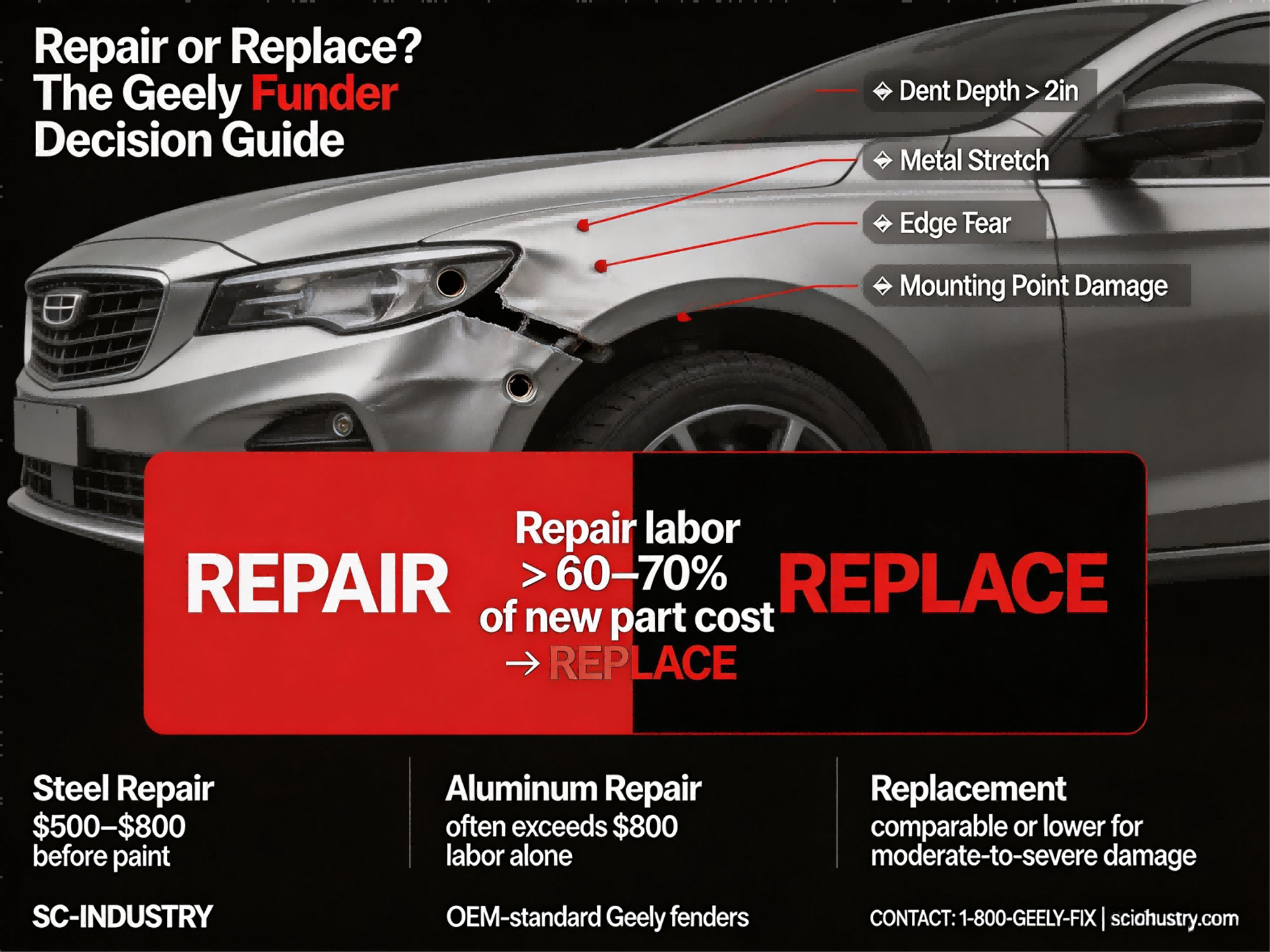
Labor hours: typically 4–8 hours for moderate damage
Aluminum fender repair:
-
Work-hardening makes reshaping progressively difficult
-
High risk of cracking or splitting during repair
-
Requires specialized equipment and separate workshop bays
-
Over 70% of U.S. body shops lack proper aluminum repair certification
-
Labor hours: often 8–10+ hours—and results are not guaranteed
The bottom line? Aluminum fenders more frequently require complete replacement rather than repair. This creates a more rigid demand for aluminum Geely fender replacement parts—a reality that body shops must plan for when estimating EV repairs.
What This Means for Your Body Shop
|
Factor
|
Steel Fender (Emgrand)
|
Aluminum Fender (Geometry C)
|
|---|---|---|
|
Repair vs. Replace
|
Usually repairable
|
Often requires replacement
|
|
Labor Time
|
4–8 hours
|
8–10+ hours
|
|
Special Equipment
|
Standard body shop tools
|
Specialized aluminum tools & separate bay
|
|
Cost Efficiency
|
Repair is cost-effective
|
Replacement is often more cost-effective
|
Your Trusted Source for Both Steel and Aluminum Fenders
At SC-industry, we understand that modern body shops need to serve both fuel and electric vehicles. That's why we supply both steel fenders for Geely Emgrand and aluminum fenders for Geely Geometry C and other EV models.
With our comprehensive supply chain management and commitment to Genuine Geely配件 (authentic Geely parts), we ensure:
-
Steel fenders matching original DC/BLD cold-rolled steel specifications
-
Aluminum fenders engineered to OE weight and strength standards
-
Consistent quality across all Geely fuel and EV platforms
-
Reliable availability for both repair and replacement needs
Whether your customer drives a fuel-powered Emgrand requiring a cost-effective steel fender repair or an EV Geometry C needing a full aluminum fender replacement, SC-industry has the right solution.
Contact SC-industry today to discuss your Geely fender supply needs—steel, aluminum, or both.
Geely Fender Repair vs Replace: A Cost-Benefit Guide for Collision Body Shops
Geely Bumper Stocking Guide for Repair Shops: Fast-Moving Parts and Inventory Tips