Selling Genuine Toyota Struts: How to Explain the Value of Original Shocks to Your Customers
2026-06-15
Selling Genuine Toyota Struts: How to Explain the Value of Original Shocks to Your Customers
You have diagnosed a worn suspension. The customer needs new front struts. Then comes the question every repair shop dreads: “Why should I pay twice as much for original Toyota struts when the aftermarket ones are half the price?”
It is a fair question. And how you answer it determines whether you close the sale at full margin or watch the customer shop for cheaper parts online. As a professional supplier of genuine Toyota parts with full supply chain management, SC‑industry helps repair shops win these conversations. In this guide, we share simple, powerful ways to explain original shock value to customer — without technical jargon — and close more sell genuine Toyota strut replacementjobs.
1. Stop Talking Specs. Start Talking Feelings.
Most technicians make the same mistake. They say: “The factory valving is different,” or “The upper bearing has tighter tolerances.” The customer hears: “Blah blah blah.” They do not care about engineering. They care about how the car will feel and how long it will last.
Instead, translate every feature into a benefit they experience every day.
|
Technical Difference
|
Customer-Friendly Translation
|
|---|---|
|
Matched compression/rebound valving
|
“The car will ride like new — not too stiff, not too bouncy.”
|
|
Precision‑machined upper bearing
|
“No clicking sounds when you turn the wheel. That cheap noise won‘t come back.”
|
|
OE rubber mount with correct durometer
|
“You won’t feel every pothole in your back.”
|
|
High‑durability seal and piston rod
|
“These will last 80,000+ km. The cheap ones often start leaking in half that time.”
|
|
Factory‑spec gas charge
|
“The front end won‘t dive when you brake hard.”
|
When you explain original shock value to customer in terms of ride quality, noise, and longevity, the price difference suddenly makes sense.
2. The Simple Demonstration That Closes Sales
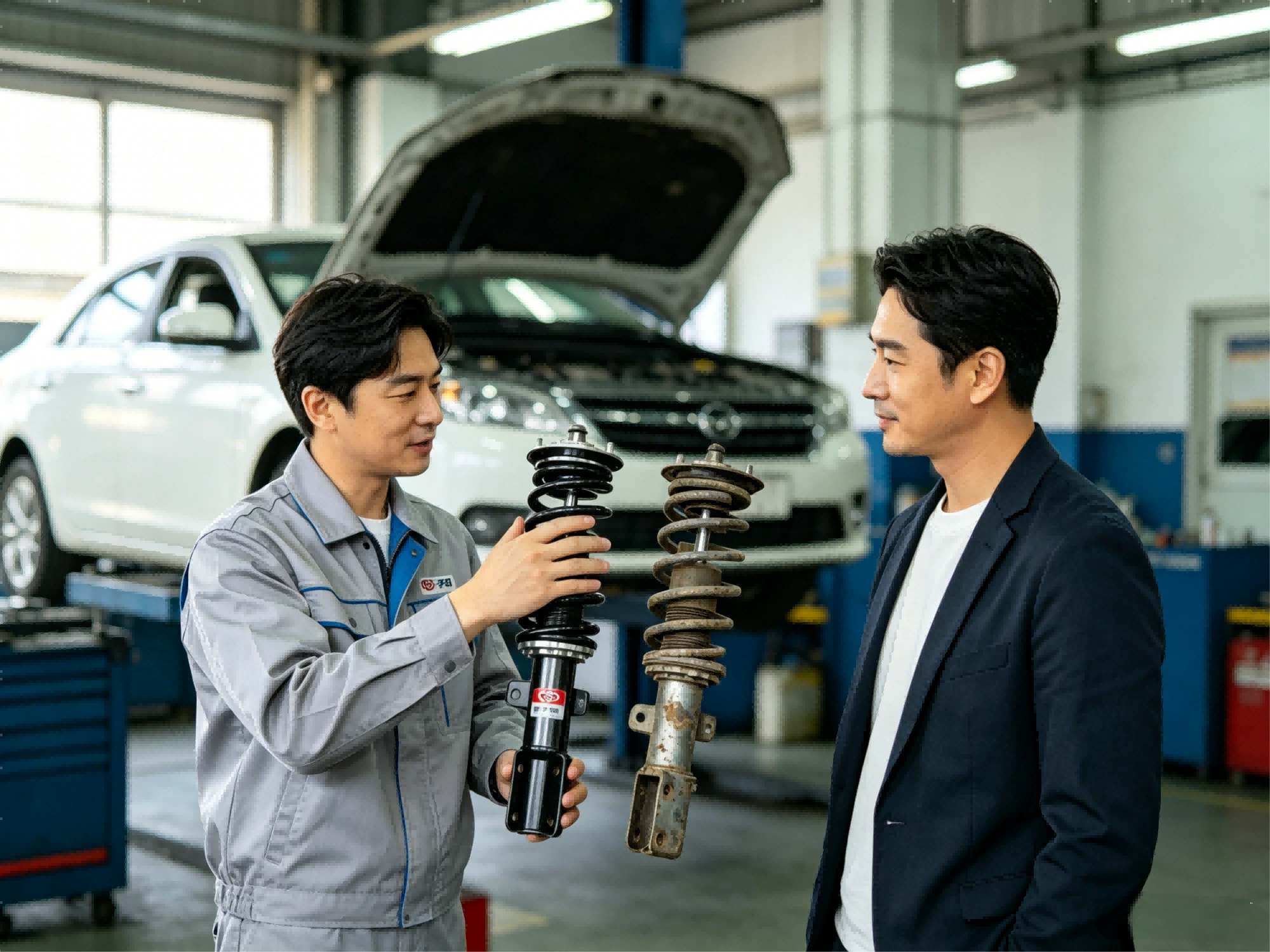
Words help. But a hands‑on demonstration is unforgettable. Keep an old worn Toyota strut (taken from a previous repair) and a brand new genuine Toyota strut in your shop. When a customer questions the price, invite them to the bench.
The Compression Test
Ask the customer to press down on the piston rod of the old strut. It moves easily with little resistance. The oil and gas have leaked past worn seals. Then ask them to press the new genuine Toyota strut. They feel firm, even resistance throughout the stroke.
What you say: “Feel the difference? The old one is soft — it‘s not controlling the wheel anymore. That’s why your car leans in corners and bottoms out over bumps. The new one has the same damping as when the car left the factory. That‘s what gives you a stable, comfortable ride.”
The Rebound Test
Pull the old piston rod all the way out and let go. On a worn strut, it drops slowly or not at all. On a new genuine Toyota strut, it extends back firmly and steadily.
What you say: “This rebound is what keeps your tires planted to the road. When it’s weak, your wheels bounce after every bump — that‘s dangerous in emergency braking or wet roads.”
This five‑second touch‑and‑feel exercise is the most powerful Toyota strut customer educationtool you have. No debate. No technical charts. Just undeniable physical evidence.
3. Why Cheap Struts Cost More in the Long Run
Customers who buy cheap aftermarket struts often return within 12‑18 months with complaints:
-
“The ride feels harsh now.”
-
“I hear a clunk over speed bumps.”
-
“The front end dives when I brake.”
-
“My tires are wearing unevenly again.”
Each of these means a repeat repair. The customer pays labor again. They might even need new tires. The cheap struts that saved them $100 upfront have now cost them $300‑400 in additional work.
When you sell genuine Toyota strut replacement, you sell peace of mind. Your customer will not see you again for suspension work on that car for 3‑5 years. That builds trust. And trust brings the car back for oil changes, brakes, and everything else.
A Script for the Price Discussion
“I understand the price difference is significant. Here is the reality: the cheaper strut will work — for about a year, maybe 18 months. Then it will start feeling loose or making noise. You will pay labor again, plus alignment again. The genuine Toyota strut is designed to last 80,000 kilometers or more, with the same ride quality as when your car was new. Over five years, the genuine part is actually cheaper because you only install it once.”
4. How SC‑industry Helps You Sell and Upsell Suspension Work
We do not just supply parts. We help you become a better repair shop upsell suspensionbusiness. Here is what we offer to our wholesale partners:
Sample Parts for Customer Demonstrations
We can provide one sample genuine Toyota strut for your shop at a discounted price — use it exclusively for the bench demonstration we described. One sample will help you close dozens of jobs.
Technical Comparison Sheets (Jargon‑Free)
We provide one‑page PDFs written for customers, not engineers. They show:
-
Ride quality comparison
-
Expected lifespan (genuine vs. cheap)
-
Common failure modes of low‑quality struts
Print these and hand them to customers who want to read at home.
VIN‑Based Fitment Confirmation
Send us the VIN. We confirm the exact genuine Toyota strut part number within 24 hours. No guesswork. No ordering the wrong part.
Wholesale Pricing That Leaves You Healthy Margin
Our pricing on genuine Toyota parts allows you to mark up competitively against dealers while still offering the customer a fair price. You win the sale. The customer wins quality.
5. Real‑World Example: A Shop That Learned the Demo
A repair shop in Oman used to lose 40% of strut quotes to customers buying cheap online parts. The owner felt frustrated. He started keeping an old worn strut and a new genuine Toyota struton his counter.
First week: three customers did the compression test. Two of them approved the genuine repair on the spot. The third asked for a price match — the shop offered a small loyalty discount and closed the deal.
After two months, his close rate on suspension work increased from 55% to nearly 85%. He now keeps samples for Toyota Corolla and Camry — the two most common models he sees.
His advice to other shop owners: “Stop arguing about price. Let the parts argue for themselves.”
6. Which Toyota Models Generate the Most Strut Replacement Demand?
Based on our sales data, these models have the highest volume of worn‑out struts entering repair shops today:
|
Model
|
Years
|
Typical Failure at
|
Notes
|
|---|---|---|---|
|
Toyota Corolla (E140/E170)
|
2008‑2018
|
80,000‑100,000 km
|
Most common sedan
|
|
Toyota Camry (XV40/XV50)
|
2007‑2017
|
90,000‑110,000 km
|
Soft original tuning wears faster
|
|
Toyota RAV4 (XA30/XA40)
|
2006‑2018
|
70,000‑90,000 km
|
SUVs wear struts faster due to weight
|
|
Toyota Hilux (AN10/AN120)
|
2005‑2015
|
100,000‑120,000 km
|
Front struts (coil‑over design)
|
|
Toyota Prado (J150)
|
2009‑2018
|
80,000‑100,000 km
|
Rear shocks also common
|
If your shop serves these models, you should have genuine Toyota strut inventory or a fast sourcing partner. SC‑industry covers all of them.
7. The Bottom Line: Value Sells. Price Alone Never Wins.
Customers who only compare price were never your long‑term customers anyway. But customers who understand value — who feel the difference in their hands and hear it explained in plain language — will choose genuine Toyota parts every time.
Your job is not to argue. Your job is to educate. The compression test takes 10 seconds. The ride quality explanation takes 30 seconds. Together, they transform a price objection into a quality decision.
SC‑industry gives you the parts, the samples, and the technical support to sell genuine Toyota strut replacement confidently.
👉 Contact SC‑industry today with:
-
Toyota model and year (or VIN)
-
Which struts you need (front, rear, left, right)
👉We will reply within 24 hours with:
-
Exact genuine part number
-
Wholesale pricing and volume discounts
-
Information on sample parts for your shop counter
Mann Oil Filter vs Aftermarket: True Cost Comparison for Distributors and Workshops
More or Fewer Motors in Geely EVs? What the Electric Vehicle Transition Means for Motor and Actuator Aftermarket