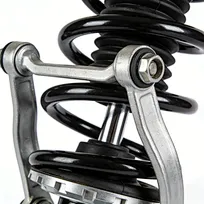
Distributors know suspension defines ride and safety – control arms, stabilizer links, tie rods, ball joints, strut mounts, and coil springs. Factory-grade bushings, ball stud taper angles, torque specs. Consistent geometry and rubber durometer across batches. Anti-corrosion coating.
Why This Matters in 2026
Suspension components are among the highest-return categories in the aftermarket. Industry data reveals that 49% of aftermarket parts ordered are returned, with poor fitment being the most common reason. Suspension parts are particularly affected — 95% of aftermarket drop links and wishbones fail and require replacement within 6 to 12 months. Independent research shows that suspension bushings on most vehicles begin to degrade mechanically at 40,000 to 60,000 km, with cracking and wear appearing after 60,000 km. For electric vehicles, the additional 300 to 600 kg of battery weight shortens the failure cycle for suspension bushings and shock absorbers to 5 to 8 years. In this guide, we share our experience supplying control arms, stabilizer links, tie rods, ball joints, strut mounts, and coil springs to distributors and repair shops across the Middle East, Southeast Asia, and Latin America, covering everything from component identification and wear diagnosis to OEM cross-reference and installation torque.
Suspension System Component Identification: What Each Part Does
The suspension system is not a single component but a network of parts working together to maintain tire contact with the road, absorb road impacts, and keep the vehicle stable during cornering and braking. Understanding what each part does is the first step to accurate diagnosis and correct part selection.
Control Arms: Connect the chassis to the wheel hub and allow vertical suspension movement while maintaining wheel alignment. Control arms contain bushings at the chassis end and a ball joint at the wheel end. Worn control arm bushings cause clunking over bumps, steering wander, and uneven tire wear.
Ball Joints: Act as the pivot point between the control arm and the steering knuckle. The ball joint allows the wheel to move up and down and left and right simultaneously. A worn ball joint causes clunking over bumps, vague steering, and uneven front tire wear.
Stabilizer Links (Sway Bar Links): Connect the stabilizer bar to the control arm or strut. They reduce body roll during cornering. Worn stabilizer links cause a distinctive clunking or rattling noise when driving over uneven surfaces.
Tie Rod Ends: Transmit steering input from the steering rack to the steering knuckle. Worn tie rod ends cause steering play, vibration, and irregular tire wear.
Strut Mounts: Act as the upper mounting point for the strut assembly and contain a bearing that allows the strut to rotate with steering input. Worn strut mounts cause a clunking or popping noise when turning the steering wheel at low speeds.
Coil Springs: Support the vehicle's weight and absorb road impacts. Broken or sagging coil springs cause the vehicle to sit unevenly and reduce ride quality.
Bushings (Silent Blocks): Rubber or polyurethane components that isolate the suspension from the chassis, absorbing vibration and allowing controlled movement. Worn bushings cause rattles, creaks, loose-feeling steering, and poor wheel alignment.
Symptoms of Worn Suspension Components: What to Look For
Before replacing any suspension component, confirm the fault is actually in the suspension — not the tires, wheel bearings, or steering system.
Clunking or knocking over bumps: worn ball joints, control arm bushings, or stabilizer links. The sound is typically a dull thud or clunk at low speeds over speed bumps or potholes.
Steering wander or pulling to one side: worn control arm bushings or ball joints allow the arm to shift under load, changing alignment angles dynamically.
Uneven tire wear (cupping or scalloping): worn shock absorbers or struts prevent the tire from maintaining consistent contact with the road.
Vibration through the steering wheel while braking: excessive play in the ball joint or control arm bushings allows the wheel to shift under braking load.
Steering shimmy at highway speeds: worn bushings or ball joints allow the wheel to oscillate.
Rattling or creaking over small bumps: worn stabilizer bar bushings or end links. This is especially common on electric vehicles where increased weight accelerates bushing wear.
Vehicle sits unevenly or sags on one side: broken or sagging coil spring.
Loose or vague steering feel: worn tie rod ends or steering rack bushings.
How to Check for Suspension Wear: The Correct Procedure
Based on SIDEM technical guidance, the correct diagnostic procedure for suspension wear involves three steps.
First, lift the vehicle until the wheels are fully off the ground. Grasp the wheel from above and below and execute a tilting movement. If you feel play or resistance changes, the ball joint may be worn.
Second, perform a visual inspection of the ball joint dust cover. If the rubber shows wear or cracks, the ball joint needs to be replaced regardless of play.
Third, test the bushings. Place a lever between the chassis and the control arm and attempt to create movement. If you can create movement of one or more centimeters, the bushings are worn and must be replaced.
Real-World Case Study: Reducing Suspension Returns for a Distributor
A distributor in Southeast Asia was experiencing a 31% return rate on suspension components. The main causes were ball joint taper mismatch (44% of returns), incorrect bushing durometer (29%), and missing installation hardware (18%).
After switching to SC Industry, we provided a VIN-based suspension compatibility check for every order, included installation hardware and torque specification sheets with each shipment, and supplied sample arms for test fitting before bulk orders. The distributor placed an initial order of 400 control arms.
Results after 12 months: return rate dropped from 31% to 5%. Repeat order value increased from $28,000 to $195,000 per year. The distributor expanded to tie rod ends and stabilizer links.
Frequently Asked Questions
Q: How do I know if my control arm needs replacing?
A: Common symptoms include clunking over bumps, steering wander, uneven tire wear, and vibration while braking. Lift the vehicle and check for play in the ball joint and bushings. A ball joint with a cracked dust cover or more than 1 cm of bushing movement requires replacement.
Q: Can I replace just the ball joint or bushing instead of the whole control arm?
A: On some vehicles, yes. However, pressing out and reinstalling a ball joint or bushing requires specialized tools and may damage the arm. For most Toyota and Geely models, replacing the complete arm assembly is faster, safer, and often more cost-effective.
Q: What happens if I install a control arm with the wrong ball joint taper?
A: The ball joint may feel tight during installation but loosen under driving load. A mismatched taper can cause the joint to separate from the steering knuckle, resulting in loss of steering control. Always verify the OEM part number before installation.
Q: Do I need a wheel alignment after replacing a control arm?
A: Yes. Control arm replacement changes camber and toe angles. A wheel alignment is mandatory after installation to prevent uneven tire wear and ensure proper handling.
Q: Why do electric vehicles wear out suspension components faster?
A: Electric vehicles typically weigh 300 to 600 kg more than equivalent combustion vehicles due to the battery pack. This additional weight increases the load on suspension bushings and shock absorbers, shortening their service life to 5 to 8 years.
Q: Do you provide installation hardware and torque specifications?
A: Yes. Every suspension component we ship includes installation hardware and a torque specification sheet for the specific vehicle application.
Q: Which Toyota and Geely models do you cover?
A: Toyota coverage includes Corolla, Camry, RAV4, Yaris, Hilux, and Fortuner. Geely coverage includes Emgrand, Boyue, Coolray, and Monjaro. Other models are available on request.